Google rarely explains itself. So when it does, I read slowly.
On November 24, Google updated a page called Our principles for ranking results. It’s short. I read it twice, once with my SEO hat on and once as a writer.
The writer read is the one I keep thinking about.
There’s no separate rulebook for AI
This is the line that stopped me:
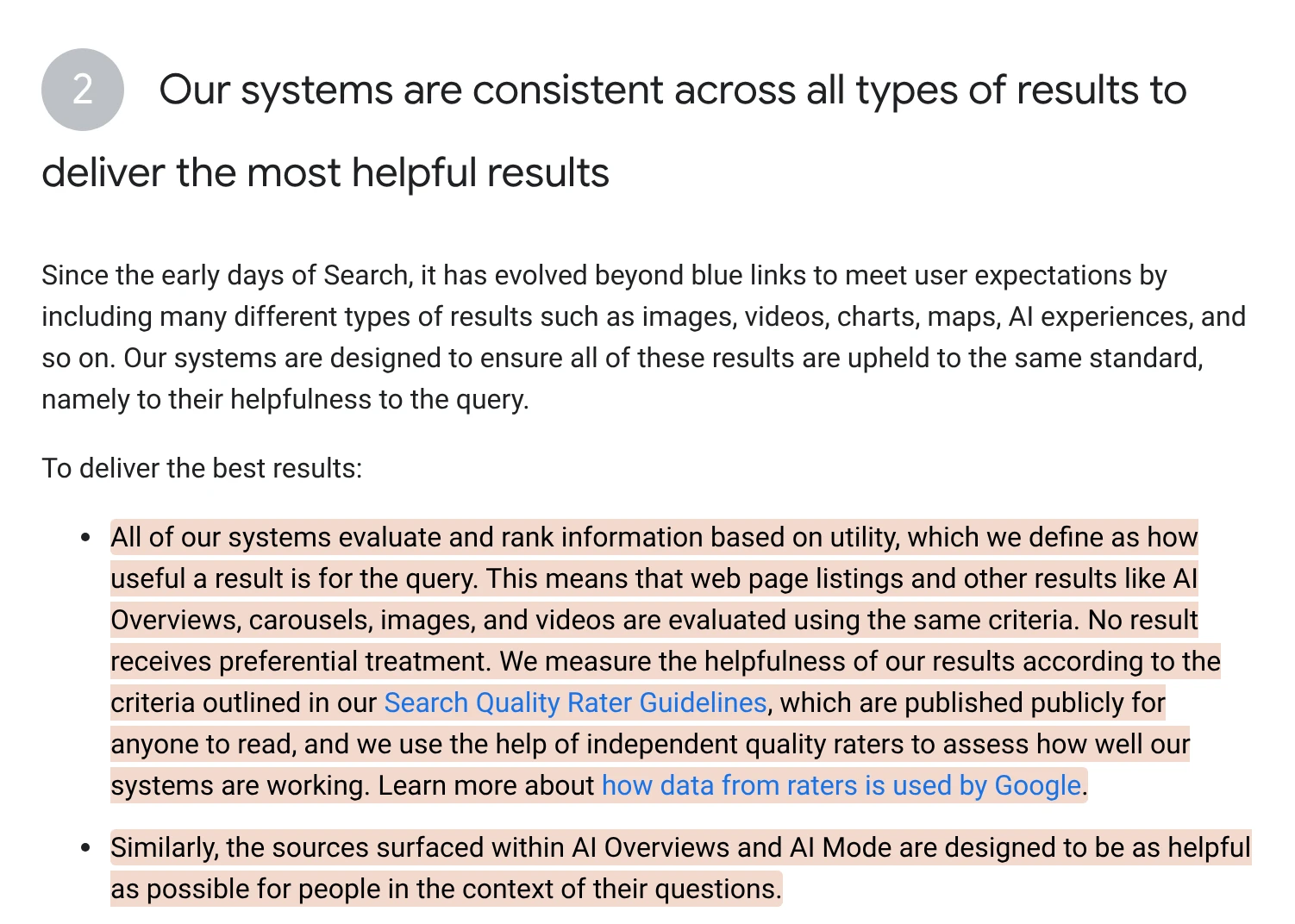
“Web page listings and other results like AI Overviews, carousels, images, and videos are evaluated using the same criteria. No result receives preferential treatment.”
Google even names the criterion. It calls it utility: “how useful a result is for the query.”
I’ve been in SEO and content for 15 years. Every new search feature came with a fresh wave of tricks, and AI Overviews were no different. I felt that pull too.
This page says there’s nothing separate to chase. The standard for an AI Overview is the same one your blog post already answers to.
Write for the question behind the keyword
There’s another line, this time about where AI Overviews and AI Mode get their sources. They’re “designed to be as helpful as possible for people in the context of their questions.”
In the context of their questions. Read that again as a writer. That’s a brief.
A keyword gives you a topic. The context tells you who’s asking, what they already tried, and what’s worrying them at 11 p.m. Listening for that is our job. We just stopped trusting it when the tools got loud.
Your experience is the edge
Google says it measures helpfulness using its public Search Quality Rater Guidelines. That’s the document behind E-E-A-T, and the first E is Experience.
Anyone can summarize what’s already published, and so can a chatbot. What you lived through is the part nobody else can write for you.
That’s good news for writers who’ve been quietly doing the work.
The little system I’m using now
Before I hit Publish, I ask myself three questions:
- What exact question is this reader asking? And did I answer it in the first two lines?
- Where’s the part only I could write? A story, a mistake or a result I saw myself.
- Would this still help someone if search engines didn’t exist? Google’s helpful content guidance asks something close to this too.
If I can’t answer all three, the draft isn’t ready. Even if the keyword is perfect.
A note to myself (and to you)
Google closes the page with a promise: “if we can’t show a change actually makes things better for people, we don’t launch it.”
I want to hold my own writing to that. If it doesn’t make things better for the reader, I don’t publish it.
If you’re on the business side, I wrote the B2B version of this, about getting cited in AI Overviews, over on settewriter.
Now your turn. Which of the three questions is hardest for you to answer before you publish? Tell me on LinkedIn. I read every one.
What did this make you think about? Tell me on LinkedIn or reply to the next newsletter. I read every one.

Growth partner in SEO content and digital marketing. I help you write and think better with systems so we can thrive and win with AI.
More about me →