Q1 2026: What a Stranger's Insult, 20 Books, and a Lot of Grief Taught Me About SEO, AI, and Showing Up
Q1 was a rollercoaster of AI experiments, community-building, grief, and 20 books and it taught me that for Filipino writers, sustainable SEO careers start with systems, sleep, and showing up on our own terms.


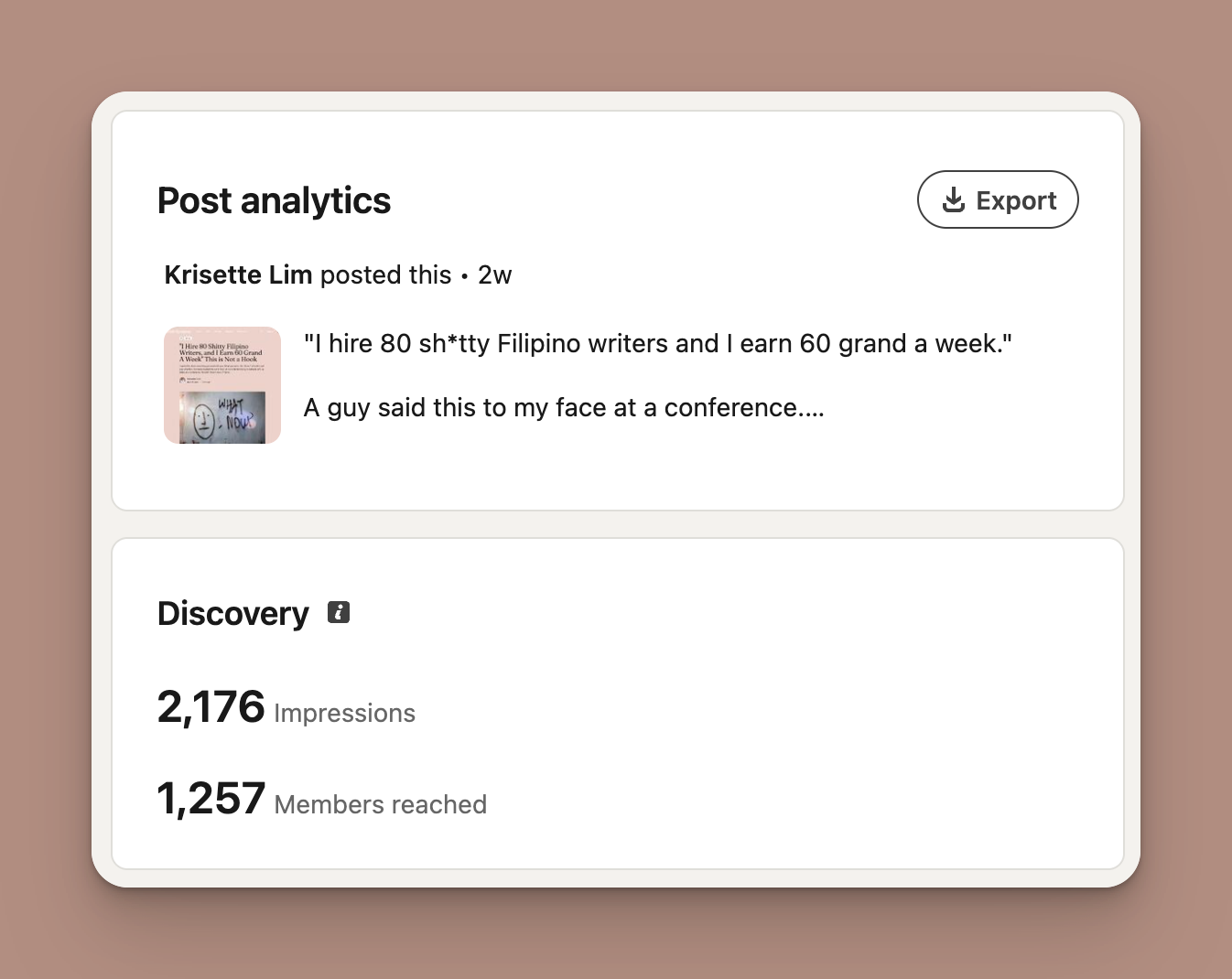
"I hire 80 sh*tty Filipino writers and I earn 60 grand a week."
A guy said that online. Casually. Like it was a flex.
I sat with it for a beat, not just because it stung, but because it said everything about the problem I've spent 15 years working against: the belief that Filipino writers are cheap inputs in someone else's content machine. Interchangeable. Not worth developing. Disposable.
That post reached 1,257 people in two weeks. Fifty engaged. Eleven left comments. Two followed me because of it.
Small numbers by most standards. But every single person who stopped to react knew exactly what that quote meant.
That's who I'm writing this for.
If you're a writer or content marketer in the Philippines, or anywhere, trying to build something real and sustainable in the age of AI, Q1 2026 was a semester.
Here's everything I learned.
January: Build the container first
I've talked about the Fresh Start Effect before, the psychology behind why temporal landmarks give our brains permission to begin again.
I lean into January intentionally, but this start of the year, I made one change: instead of setting new goals, I built a better container for them.
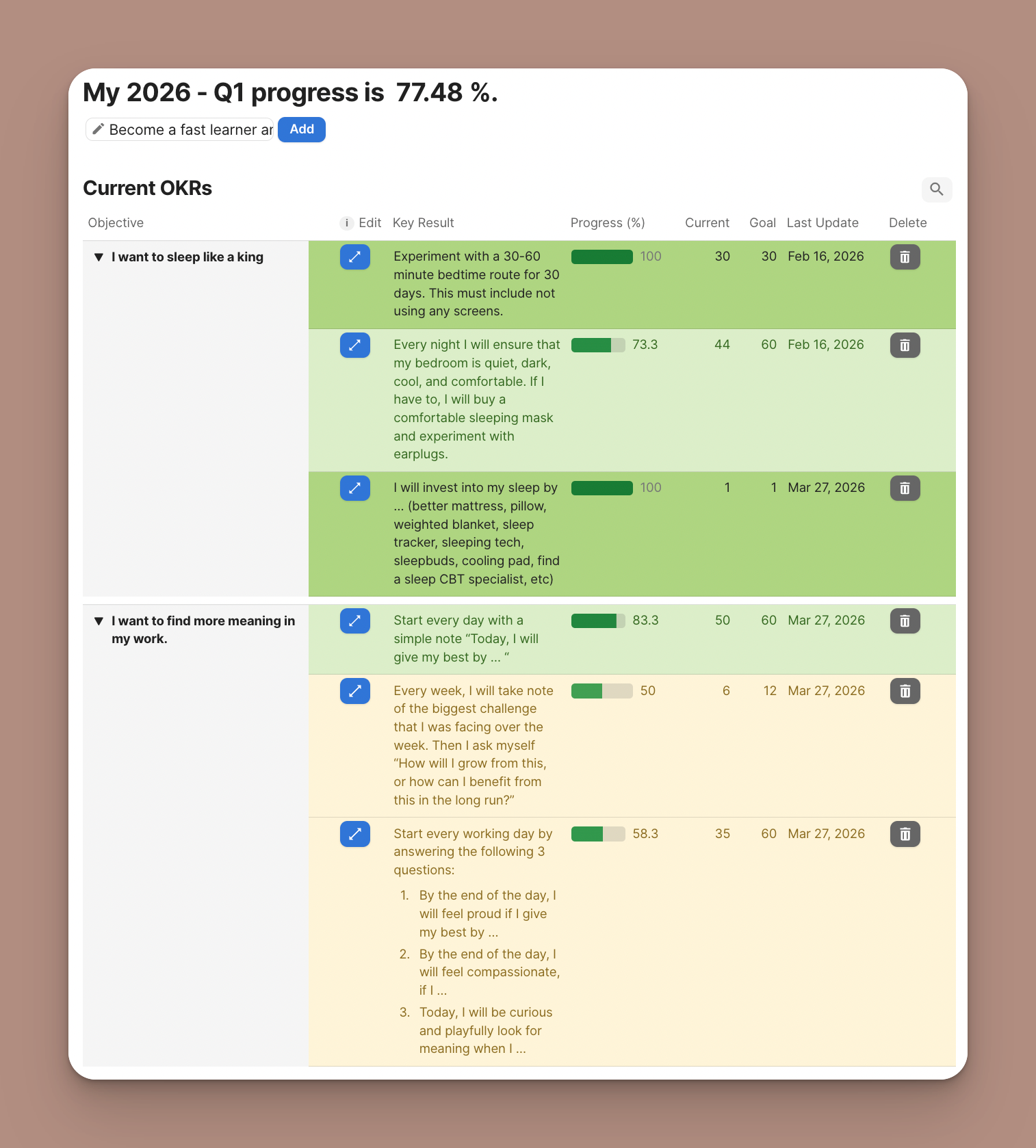
My personal OKR had two non-negotiable anchors: sleep and finding meaning at work. Not output targets. Not follower goals. Those two. Because I'd noticed the pattern: when either one slips, everything else follows. My writing gets stale. My systems get sloppy. My decisions get reactive.

This is also when I got serious about AI, not as a drafting shortcut, but as something I needed to train before it could genuinely help me.
My AI Linguistic Marker guide came out of this work: the idea that you don't fix "delve" and "leverage" after the fact; you fix what goes into the prompt. In January, I standardized tone guidelines upfront, built my Perplexity Max assistant that carried my voice, and put review loops in place, so I stopped being the cleanup crew for my own AI outputs.
One system change. Weeks of time back. That's the ROI I'll take every quarter.
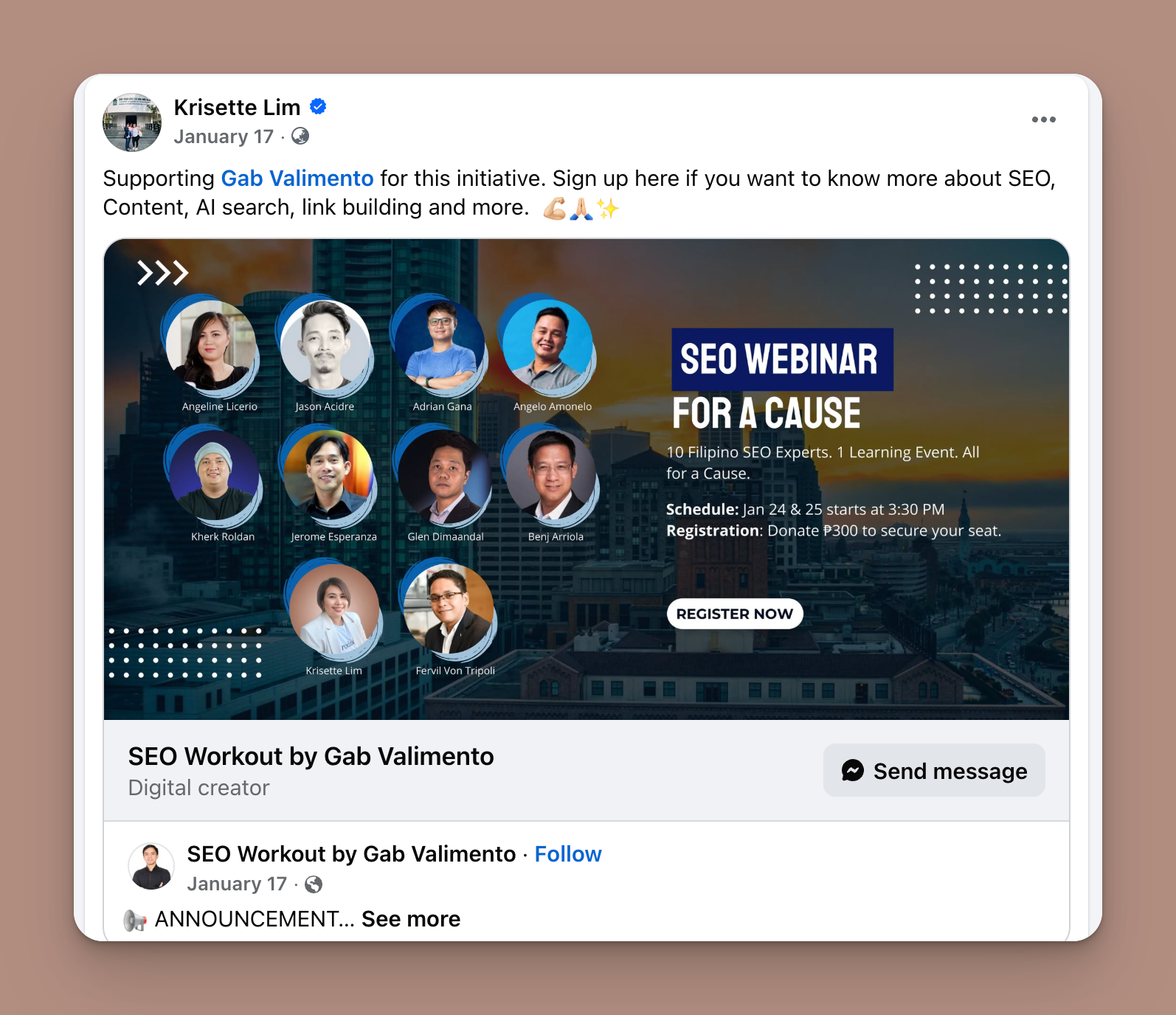
Then I got invited to speak at an SEO for a Cause webinar here in the Philippines, and that one, yes, cracked something open.
It got me asking a question I'd been quietly sitting on: "Where is my tribe? Where is my community here in the Philippines?"
I'd been plugged into communities like Superpath Community (grateful, genuinely) but aware of the gap. Western time zones. Western market assumptions. The writers and marketers I most wanted to learn alongside and lift up were right here.
January planted the seed.

February: Showing up is the strategy
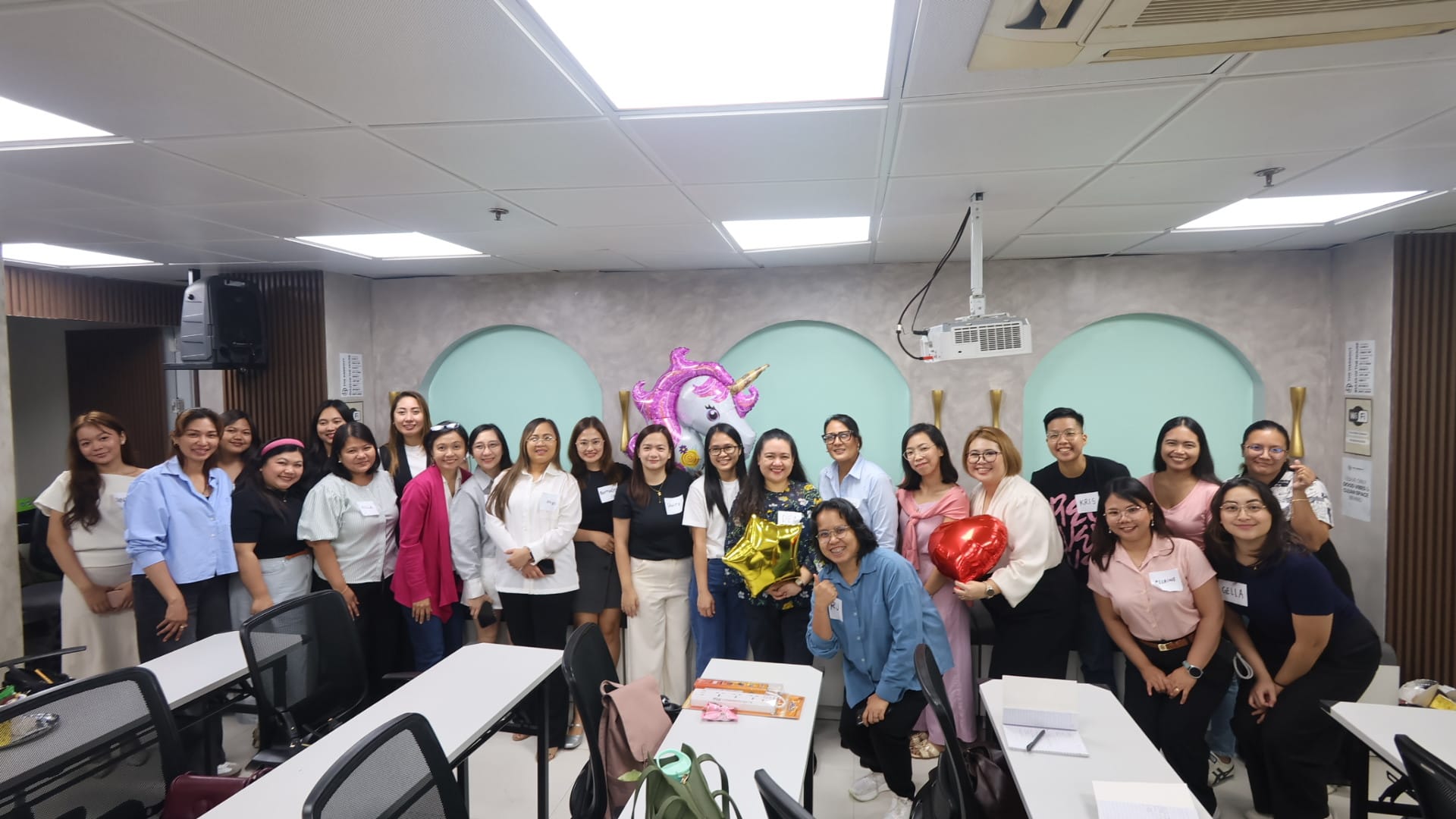
I got sick. Took a sick day. And somewhere between rest and restlessness, I posted a question in a group, asking if anyone wanted to be part of a women-in-SEO and digital marketing community in Manila.
What followed was one of the fullest months I've had in years.
Real people. Same room. Meeting faces I'd only ever known through LinkedIn comments and conference name tags, some I'd first connected with overseas, suddenly right there across a table in Manila.
There were hard parts too, personally. But here's the thing I kept writing about all February: showing up. Not performing. Not pretending.
Being present (for yourself and for others) even when it's hard.
My gut check when I lose the thread: ask why five times. By the fifth, you've hit bedrock. For me, it always traces to the same place. I want to help writers, marketers, and freelancers on this side of the world build SEO skills that are durable, systems that actually work, and voices that don't sound like everyone else's AI output. That's the reason.
February also sharpened my thinking on something I don't see talked about enough: your content ecosystem is a trust system.
Every brand you attach your name to, every tool you recommend, every AI draft you publish without real editorial judgment; it's a reflection if you care enough in giving value to others.
To your readers, to search engines, to yourself. As SEO moves further into entity reputation and AI-generated answers, author trust is no longer a soft metric.
Choose what you put your name on carefully.

March: The month that belongs to me
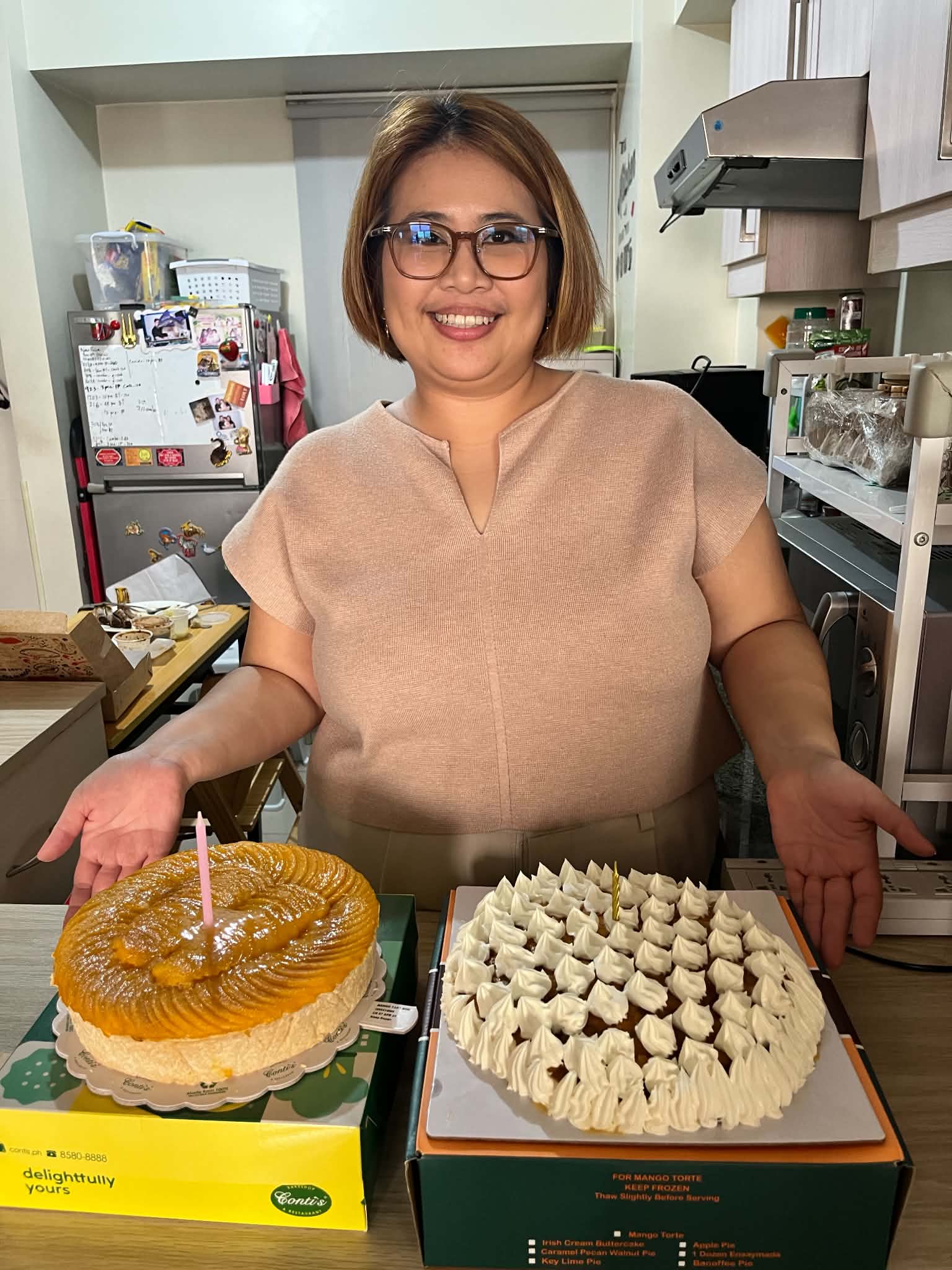
March is my birth month. It always carries more weight.
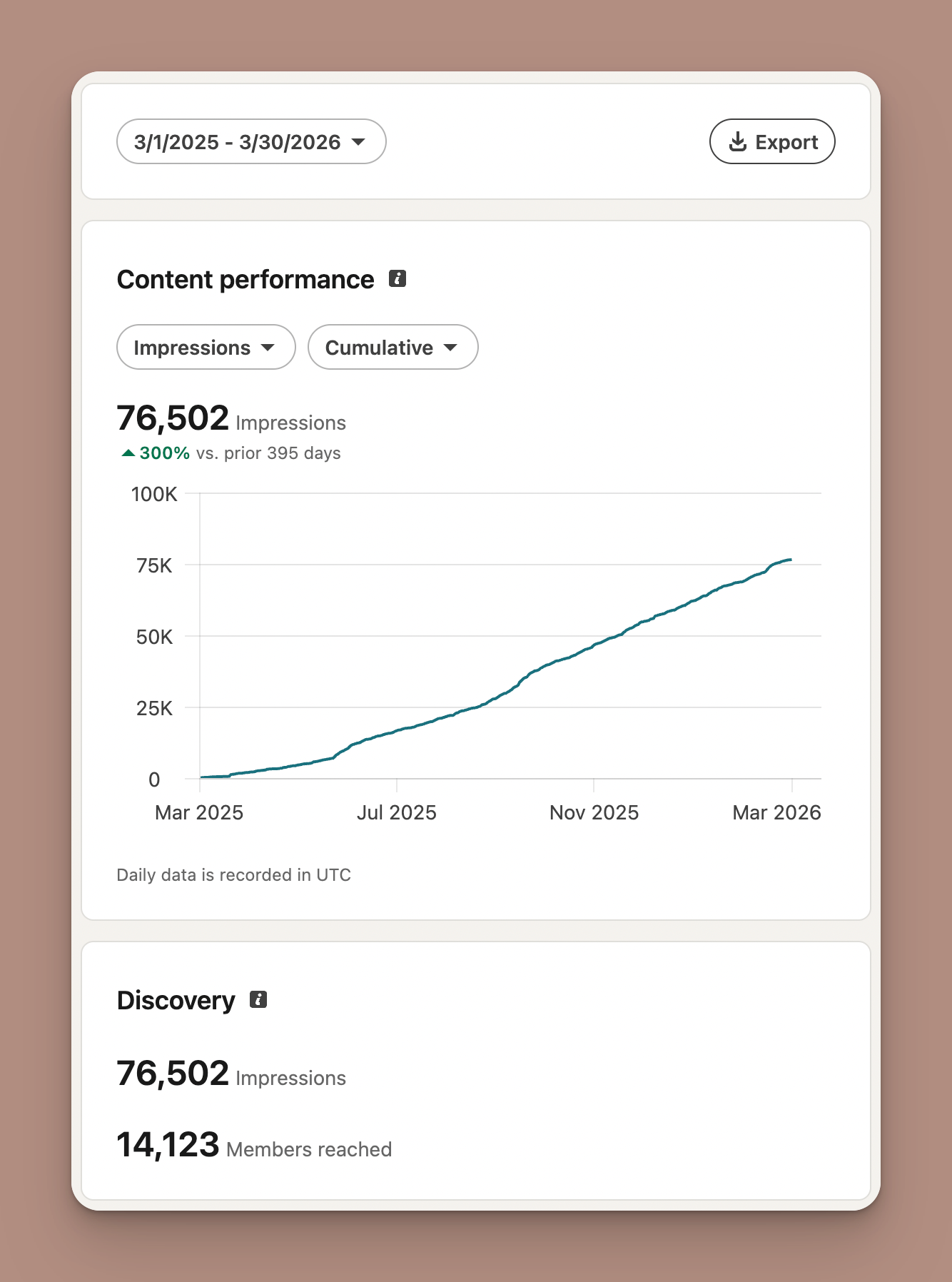
I marked one year as a content creator. Here's what a year of showing up (consistently, not perfectly) built:
- 76,502 impressions across all content
- 14,123 members reached
- 2,767 social engagements — 2,073 reactions, 649 comments, 30 saves
- 300% growth in impressions versus the year before I started
I want to be honest about why I started. It wasn't a beautiful reason.
It was FOBO: Fear of Being Obsolete. AI was quietly absorbing parts of my workflow: outlines, first drafts, research passes. The what-ifs got louder. What if my skills age out? What if I'm replaceable?
So I asked a different question: what can AI genuinely not do for me?
It can't stand on a stage like me. It can't feel a room. It can't show up on camera as a human who has failed, learned, grieved, and still chooses to share.
That's why I chose video and public speaking as my anti-obsolescence practice — not because I enjoy watching myself on screen (Day One cringe is real and documented), but because I want my work to carry my actual voice.
A year later, the number I care most about isn't the 76K. It's the real people, real responses, real conversations. The people I met online, and some of them, we eventually met personally over coffee and tea.
That's the metric that maps to community. And community is what I'm building.

March also brought a speaking moment I'm still thinking about. My high school batchmate April, who works at the Philippine Statistics Authority, asked me to speak at a webinar for PSA Region III (about resilience at work, not SEO) for roughly 70 employees across Central Luzon during National Women's Month.
 Krisette Lim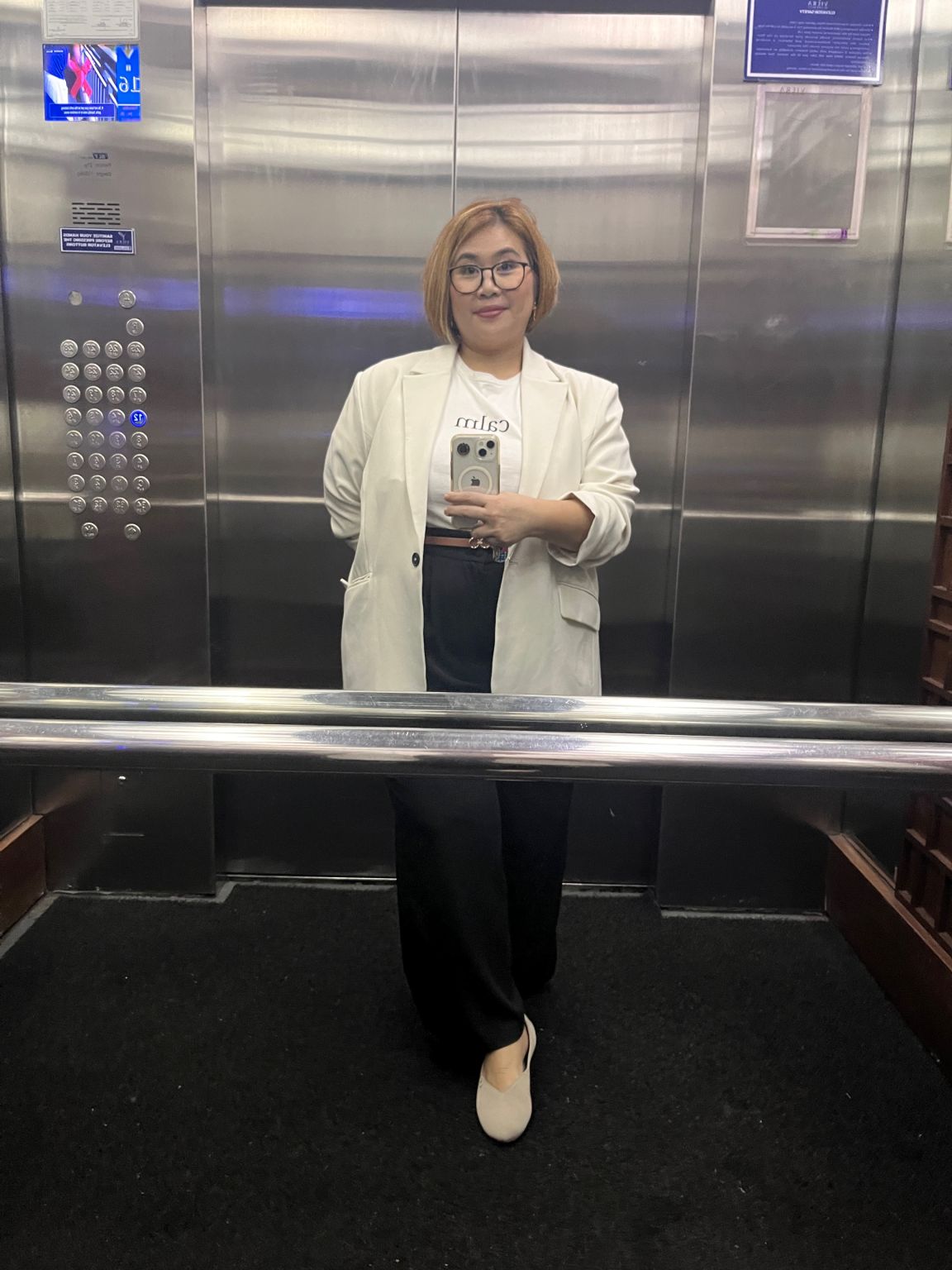
I told them: in 1988, someone in a PSA office in Region III encoded my name and details from my hospital records. To them, routine data entry. To me, that became my birth certificate, my passport, my legal existence. Every name you encode is a future. Your work is not just statistics.
I came home and turned that lens back on myself. The content brief I've written a hundred times. The SEO audit that feels like admin. It matters to someone. That reframe (every single time) helps me show up when I'm tired.
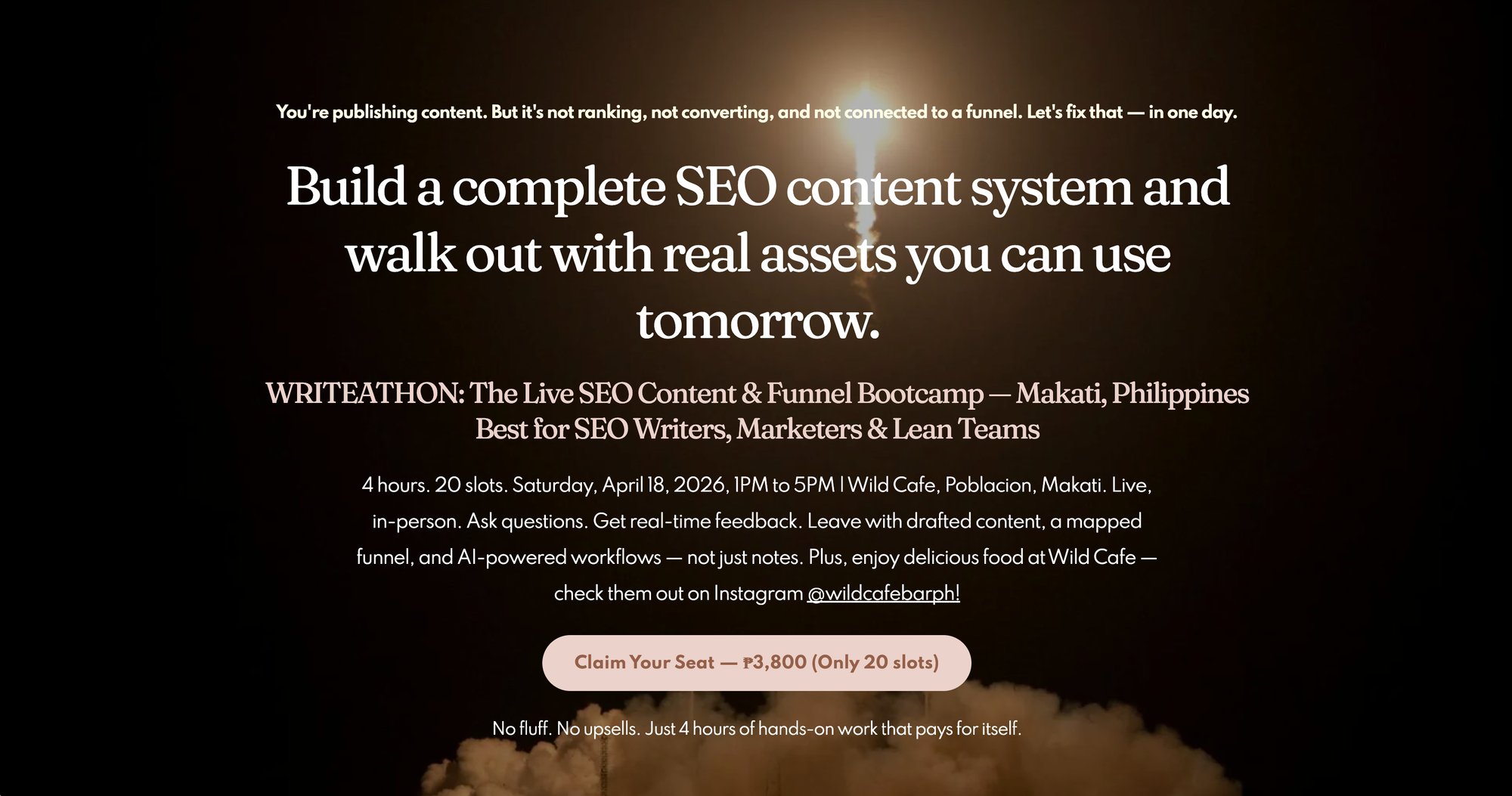
And finally, I committed to my first face-to-face SEO Content Strategy session. Four hours. 20 slots. Poblacion, Makati. April 18. ₱3,800. Venue challenges pushed the original date. But moving it isn't failing, it's choosing to do it properly.
The three RED flags

Here's what I want every writer reading this to keep.
I have three patterns that show up in me when I haven't been processing my emotions. My flags:
- Emotional eating — reaching for food to feel safe, not because I'm hungry
- Sleeping late — my body quietly rebelling against unprocessed stress
- Watching short dramas — not for rest, but for escape
When all three appear at once, I stop. I ask what I'm not letting myself feel.
This month I've been sitting with grief. March and birthdays and missing my dad, those don't pause because the quarter is ending. Losing a parent is losing part of yourself in the physical world.
There's a particular weight to a birthday when the person who brought you into the world is no longer in it. I've been trying to honor that weight this month, to sit with it rather than schedule around it.
Because when we don't process what's hard, it shows up anyway. In the flatness of our writing. In the 1 am binge. In the performance that looks fine on the surface, while something slowly hollows out underneath.
Sleep is where I keep coming back to.
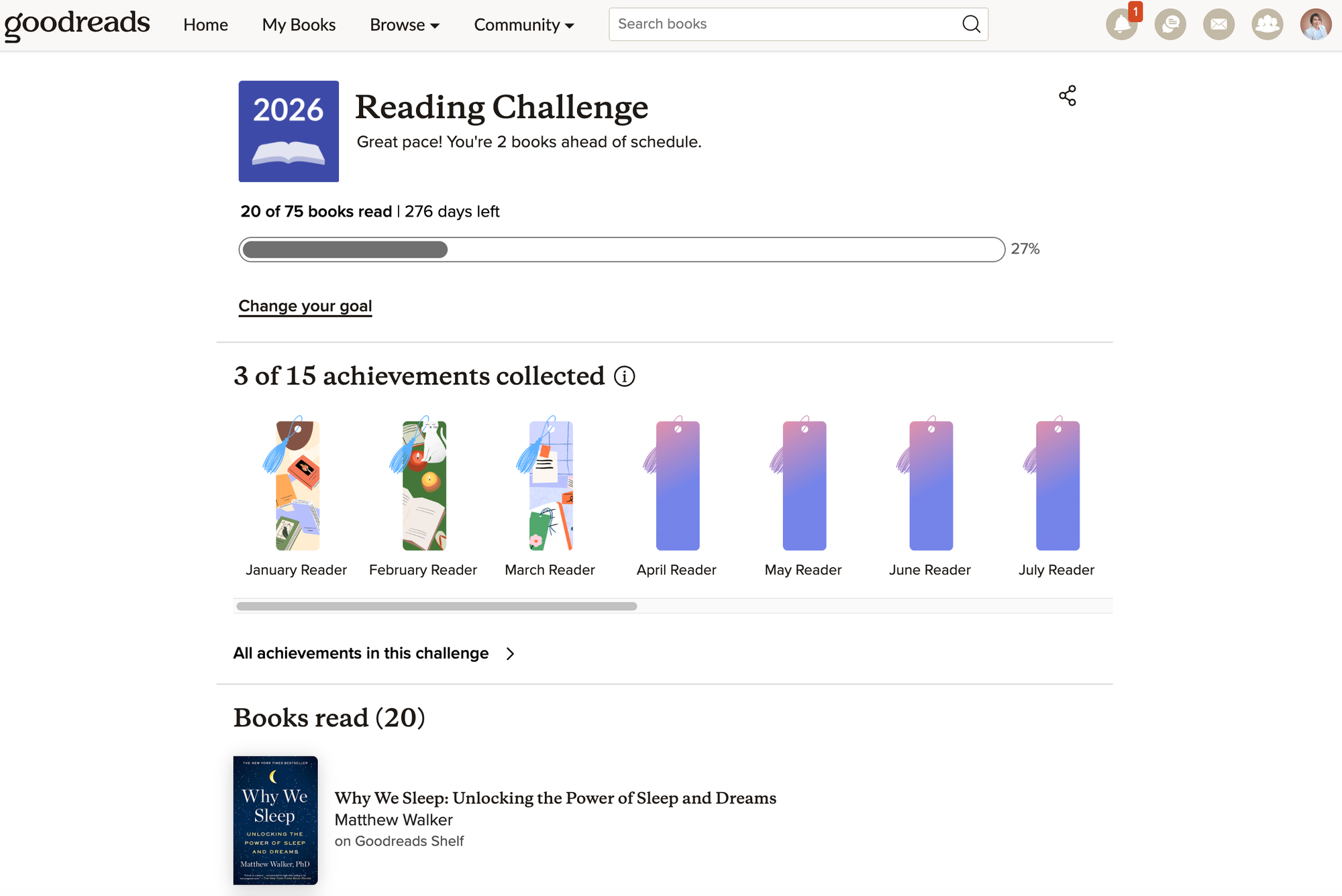
I just finished Why We Sleep by Matthew Walker this quarter, and it recalibrated everything. Sleep isn't a productivity tool. It's the foundation for recall, judgment, emotional regulation, and creative output.
When I skip it to publish more, I'm not working harder. I'm borrowing from a debt I'll pay back with worse work.
Finish the books. Sleep the hours. Process what's hard. Then ship.
What Q1 actually built
Twenty books finished. One community launched. One year of creating marked. One PSA webinar delivered on empty. One bootcamp is locked for April.
One post about Filipino writers that hit something real.
And this: a clearer sense of why I'm here, what I'm building, and who I'm building it for.
Here's what I'm taking into Q2, and what I think you can take too:
- Teach your AI before it writes for you. Prompts are briefs. Briefs need voice guidelines, context, and constraints. Don't clean up what you never should have accepted. Still write with a pen and paper. It helps you synthesize your ideas.
- Your tribe might be one honest question away. I found mine on a sick day with a random group post.
- Integrity is a content strategy. What you put your name on is a signal, to your audience, to search, and to yourself.
- Sleep is an editorial decision. You cannot write well or think clearly on chronic under-rest.
- Process what's hard or it will process you — through your coping mechanisms, your 1am drama binge, the flatness in your writing you can't quite explain.
The journey is not linear. It never promised to be.
But it has a direction. And after Q1 2026, I'm more certain of mine than ever.
Something here land with you? I'd love to know which part. Drop a comment or send me a message; real conversations are what I'm here for.
If you're in Manila and want to build your SEO content system in a room with people who get it; my first face-to-face SEO Content Strategy session is on April 18 in Makati. 20 slots only (18 slots available as of today, March 30, 2026). DM me and I'll send you the details.

