AI Brain Fry Is Real: Why More AI Means You Need More Time Away
A reflection on SEO and marketing burnout, brain fry, and the quiet cost of always being “on.”


AI made creation easier. It made sameness easier, too.
And somewhere between the tenth algorithm update and the forty-seventh AI tool launch, I started noticing something in myself and in the people around me.
We're tired. Not lazy-tired. But "fried."

I've been in SEO and content for 15 years. I've ridden out Panda, Penguin, Helpful Content, and every core update in between.
Change isn't new for me. But the speed of change right now? That's different. And I think it's costing us more than we realize.
This isn't a doom post. It's a check-in. For you, and even for me.
The ground won't stop shifting
Google rolled out a core update in March 2026. Before that, the December 2025 core update.
Before that, June and March 2025, plus an August 2025 spam update and a February 2026 Discover update in between. That's six major algorithm shakeups in roughly a year.
And it's not just updates.
A BrightEdge study from May 2025 found that while Google search impressions rose by over 49% after the launch of AI Overviews, click-throughs declined by nearly 30% on affected SERPs.
New acronyms keep piling up: GEO, LLMO, AIO. The pressure to figure it all out, right now, is real.

We're planners. We're strategists. We like knowing what works. But right now, the rules keep changing mid-game.
And pretending we're fine with that? That's its own kind of exhaustion.
AI is frying our brains (and the research proves it)
You've probably seen the term "AI brain fry" making rounds. It's not just a meme. It's a real finding.
A 2026 study by researchers at Boston Consulting Group and UC Riverside surveyed 1,488 full-time U.S. workers and found that 14% experienced what they called "AI brain fry" — mental fatigue from AI use that exceeds cognitive capacity.
People reported feeling mental fog, headaches, taking longer to make decisions, and noticing that their thoughts felt uncomfortably packed together.

The rates were highest in marketing, software engineering, HR, and operations.
Sound familiar?
Here's the part that got me: productivity drops when workers juggle more than three AI tools at once.
Then there's the hyper productivity mode.
I see it on LinkedIn. I see it in Slack groups. There's a growing badge-of-honor mentality around AI usage:
- How many credits you've burned through
- How many agents you're running
- How many workflows you've stacked.
High usage signals high performance. Or so we tell ourselves.
But the neuroscience says otherwise.
Our brains are wired to chase novelty. Every new notification, every fresh AI output, every prompt and response loop triggers a small dopamine hit .
Behavioral scientists call this the "bottomless bowl" effect — when there's no natural stopping point, we just keep going.

A Stanford study on multitasking found that heavy multitaskers felt highly productive even as their actual performance, filtering distractions, organizing memory, holding attention declined.
The mind confuses activity with progress. And that confusion, over time, fries us.
We're performing more than we're showing up
I'm going to say this because I notice it in myself first: sometimes what I put on LinkedIn isn't who I am. It's a curated, carefully angled version of who I want people to think I am.
There's nothing wrong with showing your best work.
That's smart positioning.
But there's a line. And when every post becomes a performance, we start losing something real.
A study published in Computers in Human Behavior tracked this over time. People who felt authentic on social media had fewer negative mental health outcomes two months later.
In a follow-up, participants asked to behave authentically online reported improved mood and positivity two weeks later, compared to those asked to present an idealized version of themselves.
Being real (not polished, not idealized) gave them a clearer sense of who they actually were.
The other side hurts. Research on self-presentation and online personas has linked a heavy focus on curating an idealized version of yourself to lower wellbeing over time.
The gap between who you are and who you're performing to be creates inner tension. Strain on relationships.
A quiet kind of confusion about what's real anymore.
I catch myself mid-draft sometimes.
Somewhere between the first line and the CTA, I realize I'm writing for applause, not connection.
@iamkrisettelim Between constant algorithm updates, AI tool adoption pressure, and the always-on culture, SEO and digital marketing professionals are hitting a breaking point. Well. This is my personal opinion and observation. Burnout is real, but can be avoided. Here's my 3-step system for sustainable and "meaningful growth" in 2026: 1. Start with warm-ups Just like I don't jump straight to heavy lifting at the gym, I don't tackle my hardest tasks on the first few days of January. Build momentum with easy wins first; batch simple tasks, organize your calendar, and find your cadence before going heavy. 2. Let data guide you I screenshot my LinkedIn 365-day analytics, feed it to AI, and get clarity on what worked and what flopped. This tells me exactly where to focus energy instead of guessing. I review it critically, staying in control, not relying 100% on AI. 3. Protect your offline life We're collaborating with AI tools 6-8 hours a day. Set dedicated online times and stop doomscrolling. I'm a wife, a mom, and a marketer. And my best ideas come when I'm living offline, not when I'm endlessly scrolling. Companies ignoring the burnout crisis are losing talent faster than they can replace it. Let's build a more sustainable way to work. What's your strategy for avoiding burnout this year?
♬ original sound - Krisette - SEO Content Bestie - Krisette - SEO Content Bestie
That's my cue to stop and step back.
Self-awareness isn't comfortable. But it's the guardrail that keeps the work honest, and keeps me seen and trusted for who I actually am, not a highlight reel.
What I'm doing about it (and what you can try)
I'm not going to give you a five-step plan. This one's simpler.
Minimum viable, then repeat. Three moves:
1. Build in an endpoint.
Your brain needs a stopping point, or it won't make one.
The GMU College of Public Health said it plainly: intense digital engagement should be balanced with slower thinking (walking, reading, conversation, reflection) so the brain can actually process what it takes in.
Block one hour this week. No Slack. No threads. No prompts. Just be a person.
2. Stay curious but on your own pace.
The updates won't stop. AI tools won't slow down. But you choose how much you take in and when.
One newsletter read front to back beats 47 half-skimmed LinkedIn threads. Focus on what's relevant to your work this week.
Let the rest circle back.
3. Name what you can't control, then let it go.
You can't control Google's next core update.
You can't control how fast AI ships. You can't control what the algorithm rewards tomorrow.
What you can control: the system you build, the work you can do, and how you show up for your team, your clients, and yourself. Make that doable for you. The rest is noise.
A note to myself (and maybe to you)
I need this reminder as much as anyone reading it.

The more time I spend with AI, the more time I need outside of it. The more I chase updates, the more I need to sit still. The more I perform, the more I need to check in with what's real.
Simple systems are scalable. But so is rest. So is honesty. So is being a person before being a professional.
One thing that's helped me stay grounded through all of this? Being around other people (not AI clones, not robots) who get it.
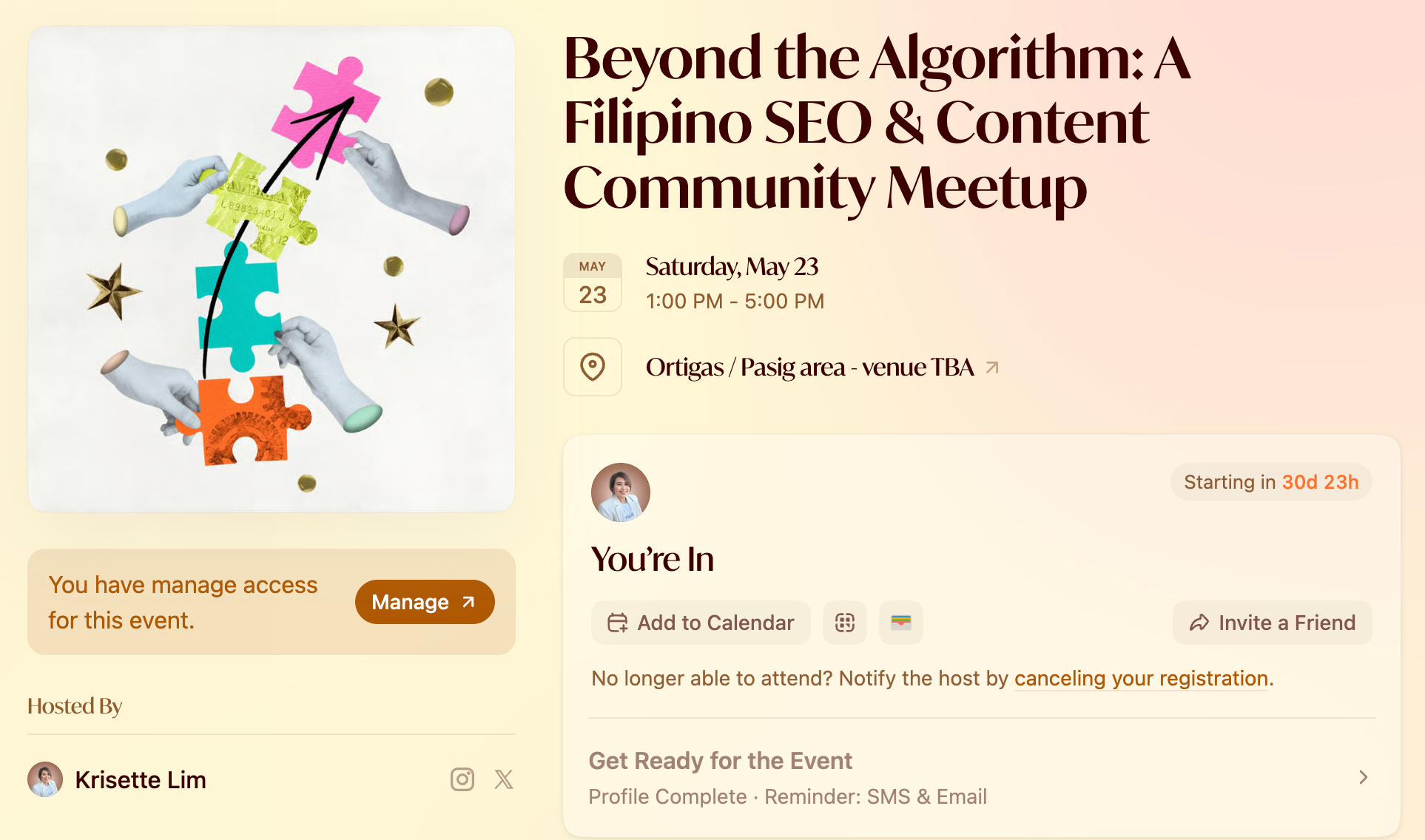
That's honestly why I keep showing up as a community builder, and why I'm looking forward to our next SEO & Content Meetup.
No agents, no dashboards, just SEO, digital marketers and content writers in a room, talking about what's actually working, what's breaking us, and how we're keeping our heads on straight through it all.
If you've been craving that kind of conversation too, come hang out.
If this resonated with you, I would like to know your thoughts as well.
Not a polished take. Just an honest one.
How are you really doing today? Drop it in the comments.

